 By
·
2 minute read
By
·
2 minute read
The energy price volatility that is taking place today has commercial and industrial business leaders exploring ways to lower energy costs. A commercial electricity price is influenced by several factors. There are conditions that cannot be controlled, such as weather and fundamental market conditions, and there are elements that can be controlled. In this blog, we discuss two costs on your energy bill, beyond commodity rate, that can help you lower commercial energy costs.
About Transmission Costs
There has been a lot of recent movement in transmission costs within regions of PJM. This year, the capacity auction that was originally slated for January 25, 2022 was moved to May 1, 2022. In addition, the Federal Energy Regulatory Commission (FERC) is reverting to the previous market design for the May 1, 2022 auction; a backward-looking Net Energy & Ancillary Services Revenue Offset rather than forward-looking. The result could lead to an increase in charges to end-users. The extent of these changes is currently unknown.
In PJM, the mechanism that transmission owners use to recover their annual transmission costs, and revenue requirements from PJM customers, is called Network Integration Transmission Service (NITS). NITS charges can change as costs associated with operation and maintenance, tax, cost of capital or rate base and transmission owner cost of services fluctuate.
How Transmission Costs Are Calculated
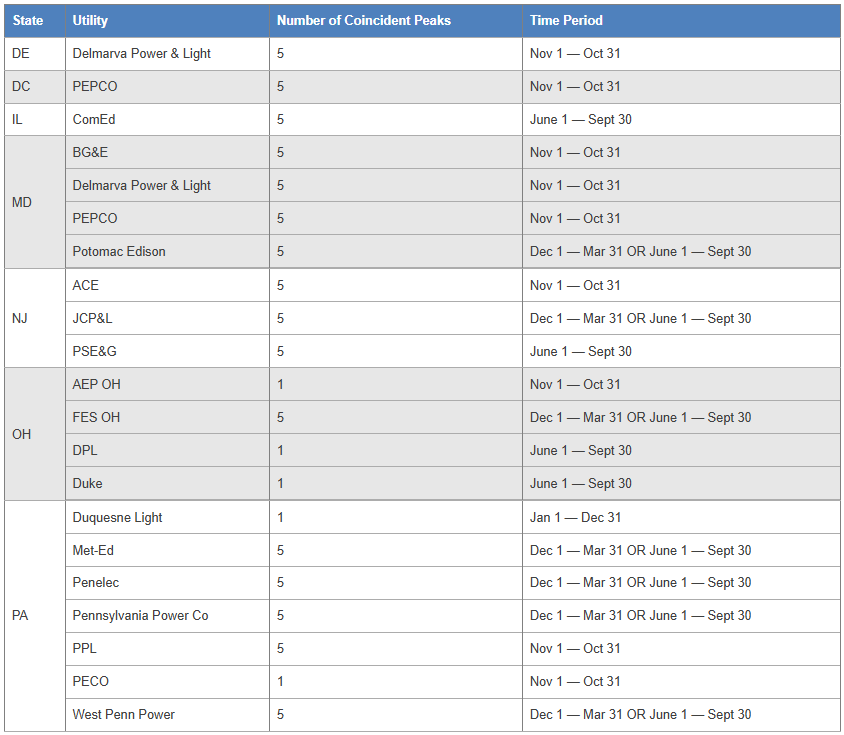
Each local distribution company within PJM has a network transmission service peak load contribution (PLC) requirement. Like capacity tag costs, NITS (and Transmission Enhancement Charges) are calculated based on a customer’s peak-load demand and are referred to as the Transmission Tag, or Transmission PLC. The transmission tag uses the following formula:
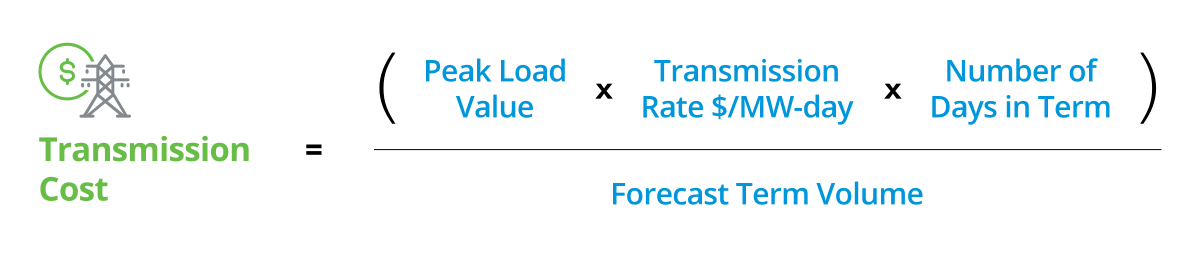
Your Network Service Peak Load (NSPL) is calculated based on the highest demand hour(s) of the year and can be decided upon by the local distribution utility.
How capacity charges are calculated
The capacity charge is one cost that can be affected by proper management. Your capacity charge is made up of two main components: capacity cost and capacity tag.
Capacity cost: The generation price set per kilowatt-hour
Capacity tag: The total kilowatt-hours used by a facility on the peak hour(s) of the peak day(s)

What You Can Do to Reduce Costs
There are ways that commercial customers can take action to reduce and control transmission and capacity costs. Depending on your risk budget tolerance, it may make sense for you to “pass through” these costs so that you can manage them through demand reduction measures to obtain lower tags. By effectively predicting the potential peak day(s), companies can temporarily reduce their electricity usage to lower their tags for the next capacity year. A reduction in the transmission and capacity tag will help mitigate the increase in the costs going forward and generate savings.